









Standard Collaborative Robotic Arm
A standard collaborative robotic arm (cobot) is a safe, flexible automation solution designed to work directly alongside humans in shared workspaces without the need for safety fencing. Built around highly integrated modular joint actuators that combine frameless torque motors, harmonic reducers, encoders, servo drives, and torque sensors, our 6-axis collaborative robotic arms deliver high precision, smooth motion, and reliable performance for industrial automation, healthcare, research, education, and commercial applications. We supply the robot arm mechanical body only, allowing customers to integrate their own controllers, software, vision systems, and end-effectors through open interfaces and standardized mechanical and electrical specifications for fast, customized system development.
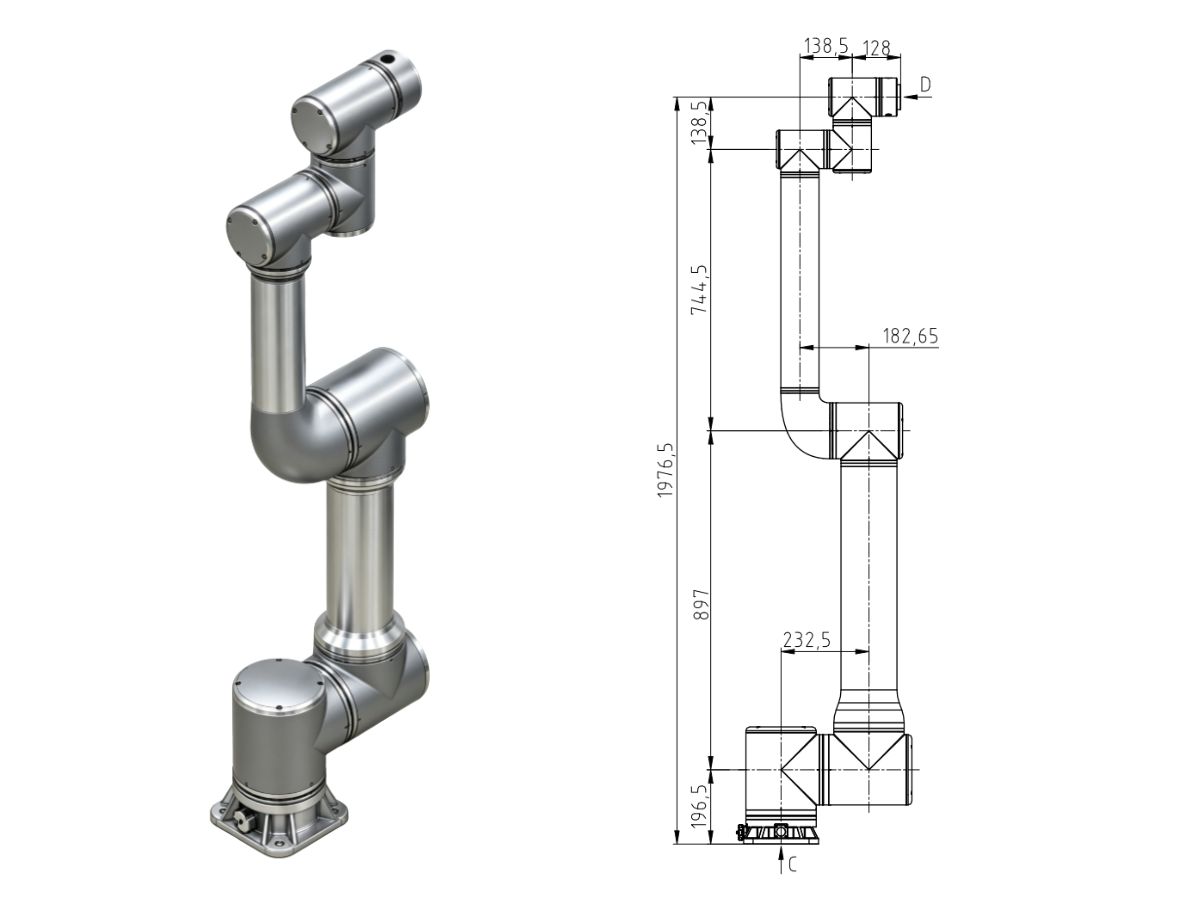
 CR-20E-C00 Heavy-Duty 6-Axis Collaborative Robot ArmThe CR-20E-C00 is a high-payload six-axis collaborative robot (cobot) with a 20 kg capacity and a lightweight 65 kg body. It offers a maximum reach of 1641.5 mm, making it suitable for large-part handling, heavy assembly, and palletizing applications.
With ±0.1 mm repeatability, it delivers stable precision within its class. The joint design supports ±175° rotation on J1/J2 and continuous ±360° on J6, enabling flexible motion in compact industrial environments.
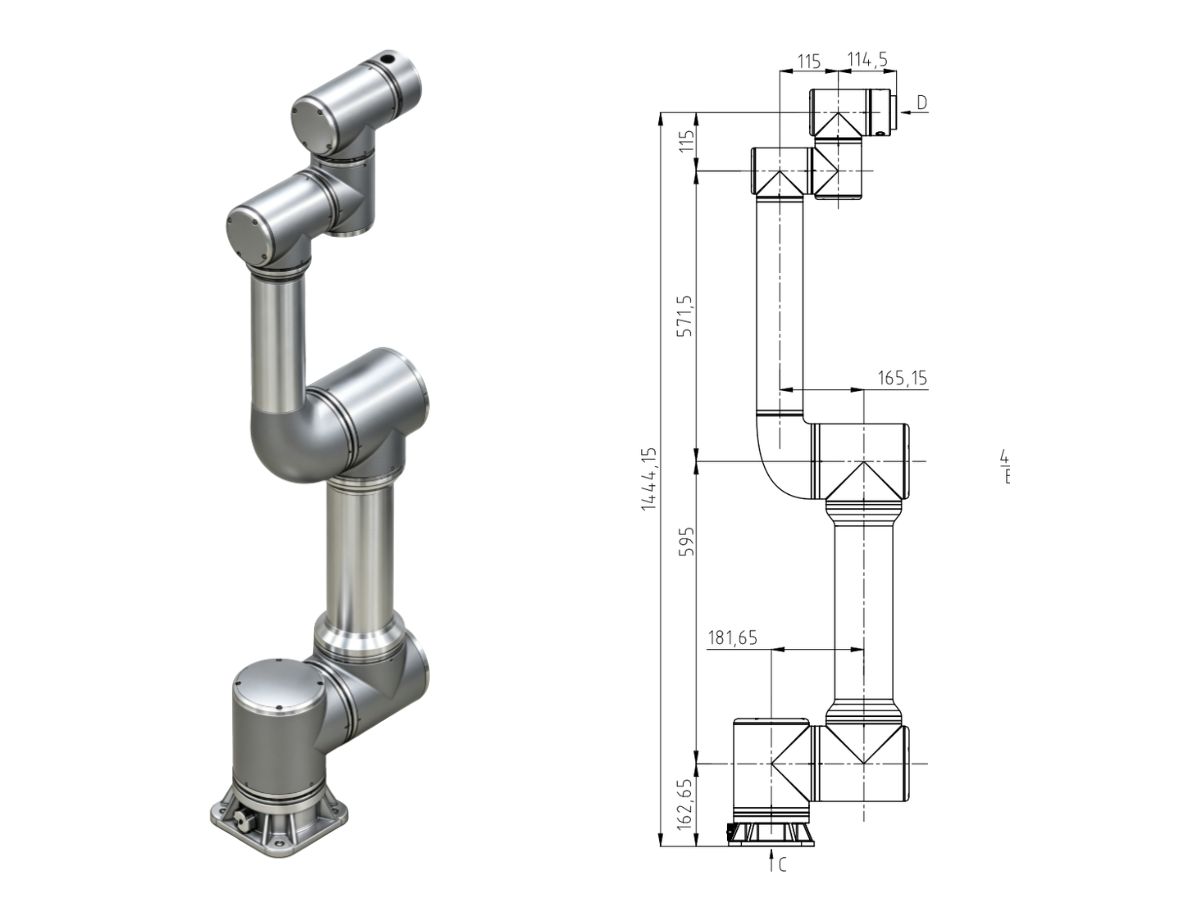
Built for harsh conditions, it features IP54 protection and operates from 0°C to 60°C, ensuring reliable performance in dusty and oil-mist environments such as automotive and metal processing. With a payload-to-weight ratio of about 1:3.25, it combines strength with easy deployment for flexible production lines.Details- CR-12E-C00 6-Axis Collaborative Robot (Cobot)The CR-12E-C00 is a 6-axis collaborative robot (cobot) with a 12 kg payload and a lightweight body weighing only 36 kg. Featuring a 1281.5 mm working radius, it provides a larger workspace coverage for industrial automation applications such as material handling, assembly, and palletizing. With a repeatability of ±0.1 mm, the robot meets the accuracy requirements of most general industrial tasks. Its IP54 protection rating and wide operating temperature range of 0°C to 60°C ensure stable and reliable operation in harsh environments such as dust, humidity, and complex production conditions.Details
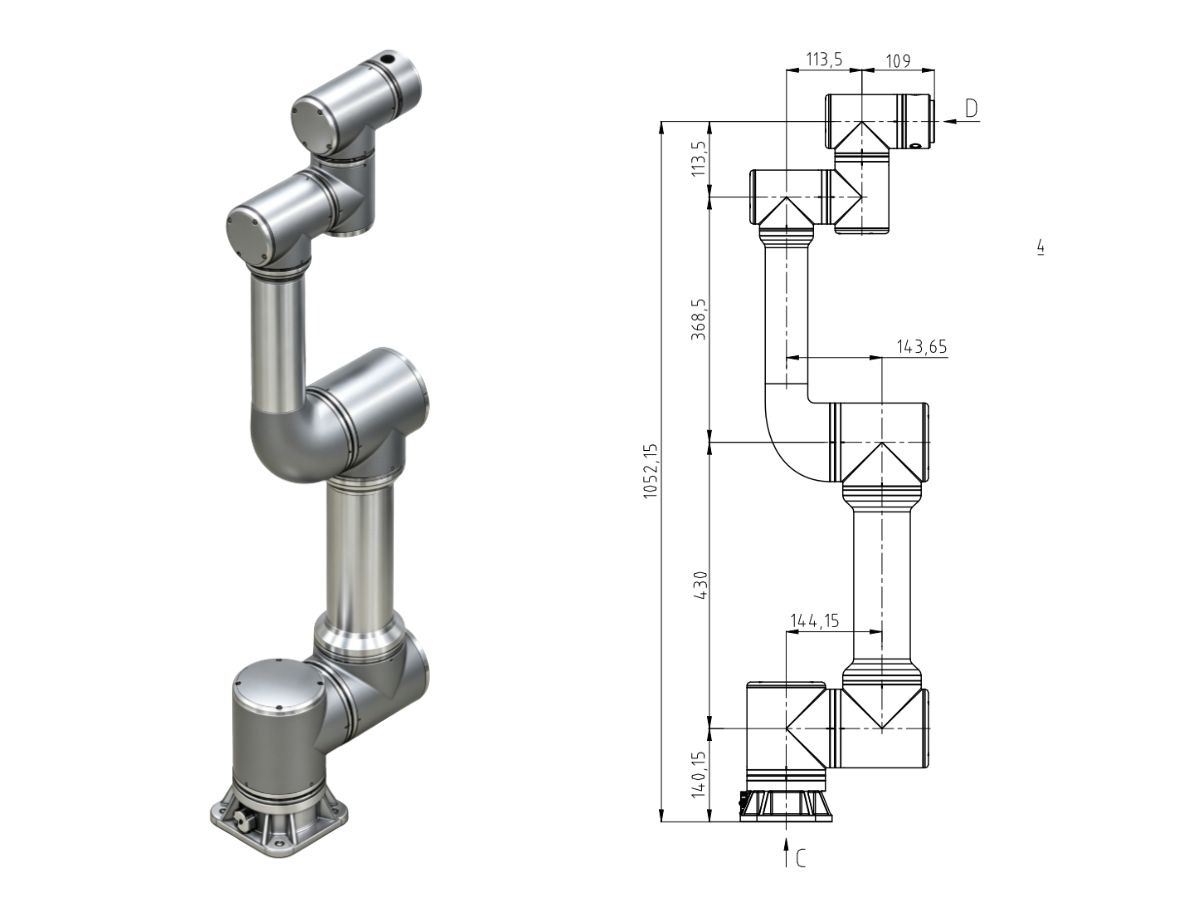
- CR-05E-C00 6-Axis Collaborative Robotic ArmThe CR-05E-C00 is a 6-axis collaborative robotic arm (Cobot) with a 5 kg payload and a lightweight body weighing only 24 kg. Featuring a 912 mm working radius and ±0.05 mm repeatability, it provides an excellent balance of precision and flexibility for applications such as precision assembly, machine tending, material handling, and quality inspection. With an IP54 protection rating and an operating temperature range of 0°C to 60°C, the robot ensures reliable performance in demanding industrial environments.Details
What is a Standard Collaborative Robotic Arm?
A standard collaborative robotic arm (Cobot) is an advanced automation solution specifically designed to work safely alongside humans in a shared workspace. Unlike traditional industrial robots that prioritize maximum speed and payload, collaborative robots focus on safe human-robot collaboration, enabling operators and robots to perform tasks together without the need for safety fencing.
Collaborative robotic arms have transformed modern manufacturing by removing the physical barriers that once separated people from industrial robots. They provide a safer, more flexible, and highly efficient automation solution for factories, laboratories, educational institutions, and commercial applications.
Our company specializes in supplying the mechanical body of collaborative robotic arms. Customers can integrate their preferred controllers, software platforms, vision systems, sensors, and end-effectors according to their project requirements.
Structure of a Collaborative Robotic Arm
Our collaborative robotic arm consists of the following core components:
- Base
- Robot links
- Modular joint actuators
Each modular joint actuator integrates multiple high-performance components into a compact unit, including:
- Frameless torque motor
- Harmonic reducer
- High-resolution encoder
- Integrated servo driver
- Torque sensor
This highly integrated design delivers excellent motion accuracy, compact dimensions, lightweight construction, and reliable performance.
The most common configuration is a 6-axis collaborative robotic arm, providing excellent flexibility for complex manipulation and automation tasks.
Key Features and Advantages of Collaborative Robotic Arm
Compared with conventional industrial robots, collaborative robotic arms offer several significant advantages.
High Safety
Safety is the primary design principle of every collaborative robot.
Through integrated torque sensors and collision detection technology, the robot can immediately reduce speed or stop when unexpected contact is detected. The robot's operating speed and output force are also carefully controlled to minimize risks. Lightweight construction and smooth rounded surfaces further enhance operator safety.
Human-Robot Collaboration
Collaborative robotic arms are designed to work directly alongside people without requiring large protective safety fences. This enables manufacturers to combine human flexibility with robotic precision, significantly improving production efficiency.
Easy Programming
Most collaborative robots support drag-and-teach programming and intuitive graphical programming interfaces, allowing operators with little robotics experience to quickly create automation tasks without extensive coding knowledge.
Flexible Deployment
Thanks to their compact size and lightweight design, collaborative robotic arms can be installed quickly and easily relocated between different workstations. They are ideal for flexible manufacturing environments with low-volume, high-mix production.
Applications of Collaborative Robotic Arms
Collaborative robotic arms are widely used across numerous industries.
Industrial Manufacturing
Industrial automation remains the primary application for collaborative robotic arms. Typical applications include:
- Precision assembly
- Screwdriving
- Welding
- Machine tending
- Pick and place
- Packaging
- Palletizing
- Quality inspection
- Grinding and polishing
- Spray painting
Medical & Healthcare
Collaborative robots assist with precision dispensing, rehabilitation training, laboratory automation, and other tasks requiring accurate and repeatable motion.
Aerospace & Hazardous Environments
Cobots can perform inspection, assembly, and maintenance tasks in aerospace manufacturing, high-temperature workshops, and hazardous industrial environments where human exposure should be minimized.
Commercial Automation
Emerging applications include:
- Smart coffee machines
- Automated food preparation
- Retail automation
- Self-service vending systems
- Research & Education
Universities, research institutes, and robotics laboratories use collaborative robotic arms for:
AI algorithm development
- Robot control research
- Machine vision integration
- Robotics education
- Human-robot interaction studies
Why Choose Our 6 axis Collaborative Robotic Arms?
Our 6-axis collaborative robotic arm features highly integrated modular joint actuators that combine frameless torque motors, harmonic gear reducers, encoders, servo drives, and torque sensors into a compact architecture. This design provides outstanding positioning accuracy, smooth motion control, high reliability, and easy system integration.
Whether you are developing industrial automation equipment, AI-powered robotics, research platforms, or intelligent manufacturing solutions, our collaborative robotic arm provides a flexible mechanical platform that can be customized with your preferred control system and software to meet diverse application requirements.
Honpine 6 Axis Collaborative Robot Arm FAQ
Honpine provides three standard 6 Axis Collaborative Robot Arm models designed for different payload requirements and industrial automation applications:
CR-05E-C00: Maximum payload 5kg
CR-12E-C00: Maximum payload 12kg
CR-20E-C00: Maximum payload 20kg
Customers can select the most suitable collaborative robot arm model according to payload requirements, working range, cycle time, and application needs.
Different models provide different working ranges:
CR-05E-C00: 912mm reach
CR-12E-C00: 1281.5mm reach
CR-20E-C00: 1641.5mm reach
The different reach options allow Honpine 6 axis robot arms to be used in various applications, including precision assembly, machine tending, material handling, packaging, and automated production lines.
The repeatability specifications are:
CR-05E-C00: ±0.05mm
CR-12E-C00: ±0.10mm
CR-20E-C00: ±0.10mm
High repeatability enables the collaborative robot arm to meet the requirements of electronics manufacturing, precision assembly, inspection, and industrial automation applications.
The maximum TCP speed of Honpine 6 Axis Collaborative Robot Arm can reach 3m/s.
The optimized motion performance provides a balance between high operating efficiency and smooth movement, making it suitable for high-speed material handling, machine tending, and automated manufacturing applications.
Honpine collaborative robot arms adopt an integrated mechanical design.
The performance of each model is evaluated based on the overall payload capability and motion performance of the complete robot system. Each model is carefully matched and tested to ensure stable operation within the rated payload range.
The robot arm weight varies by model:
CR-05E-C00: 24kg
CR-12E-C00: 36kg
CR-20E-C00: 65kg
The lightweight structure improves installation flexibility and reduces the overall load requirements of automation equipment.
Yes.
Honpine 6 Axis Collaborative Robot Arm is designed for industrial continuous operation. Under rated payload conditions and recommended working environments, the robot can support long-term continuous operation.
The precision service life of Honpine collaborative robot arm can reach 15,000 hours.
Under proper operating conditions, the robot maintains stable motion performance and positioning accuracy over long-term operation.
Yes.
Honpine 6 axis robot arm is suitable for repetitive automation tasks such as:
Machine loading and unloading
Automated assembly
Inspection
Sorting applications
Proper model selection based on rated payload is recommended for high-frequency operations.
Honpine collaborative robot arm adopts an active cooling design to optimize thermal management.
The improved heat dissipation performance helps maintain stable operation and extend product service life during continuous working conditions.
The standard Honpine 6 Axis Collaborative Robot Arm does not support continuous unlimited rotation or hollow shaft cable routing.
The product adopts a standard mechanical structure design optimized for industrial automation applications.
Honpine provides the robot arm body only.
The standard product does not include a robot controller. Customers can select their preferred robot control system according to their application requirements.
Yes.
Honpine collaborative robot arms can be integrated with various third-party robot control systems, including platforms such as:
KEBA
Nabtesco/Nabote (customer-selected controller systems)
Customers can also develop their own control solutions.
Yes.
Customers can perform secondary development based on their own control systems, including:
Motion control
Trajectory planning
Vision integration
Automation software development
This enables customized robot applications and system integration.
The Honpine robot arm body does not include a controller.
The hand guiding function depends on whether the selected robot controller supports this feature.
Honpine provides technical documents including:
Robot arm specification sheets
Mechanical drawings
Installation drawings
User manuals
Offline programming software depends on the customer's selected robot controller platform.
Yes.
Customers can import the robot model into digital twin platforms, robot simulation software, or virtual commissioning systems for offline validation and optimization.
Yes.
Trajectory planning can be implemented through the customer's selected robot controller or software platform.
Yes.
The robot arm can integrate with:
Industrial cameras
2D vision systems
3D vision systems
to achieve applications such as:
Vision-guided picking
Object positioning
Quality inspection
Smart manufacturing
Yes.
By integrating a six-axis force sensor and suitable control system, the robot can achieve:
Force control
Compliance control
Constant force assembly
Precision insertion applications
Honpine provides technical materials including:
Product specifications
Mechanical dimension drawings
Installation drawings
User manuals
Basic technical documentation
These documents help customers complete equipment design, integration, and application development.